NYT Crossplay: Play and Spell
- 4.7
- Rating
- 1.00M
- Installs
- Free
- Price

 Analysis by App-foxy
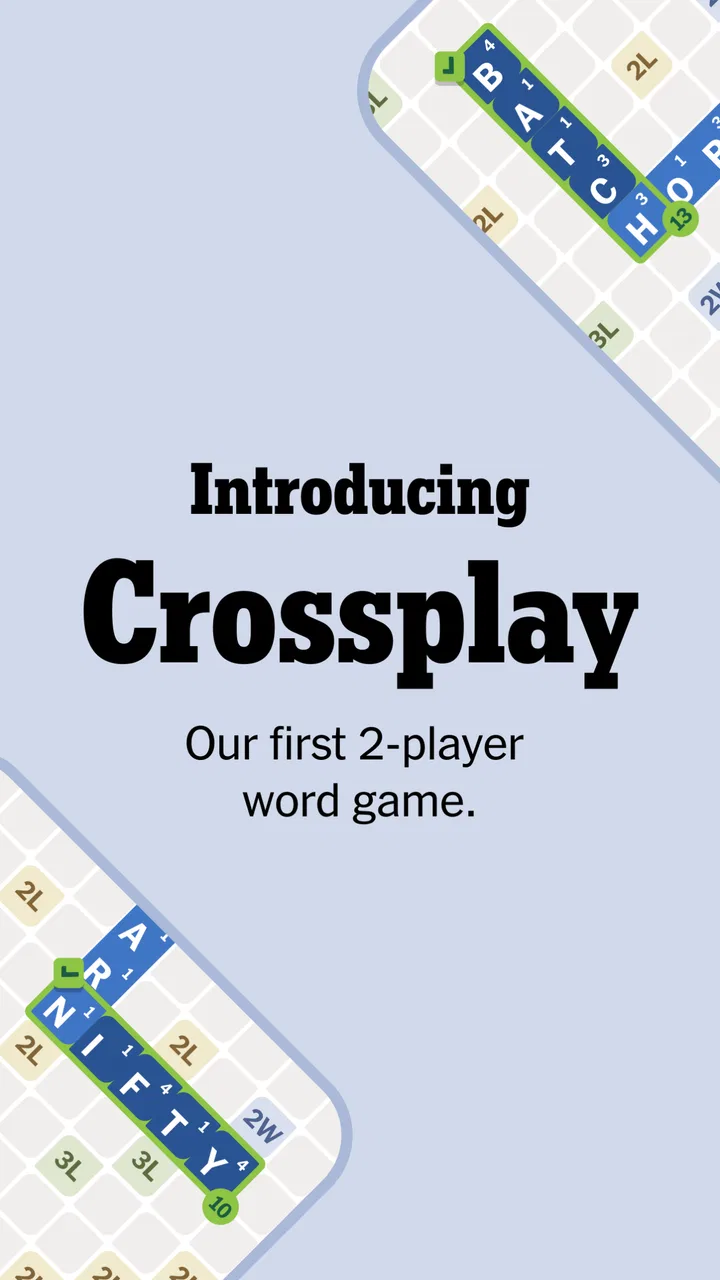
Some word games feel like exercises, while others create the kind of small ritual that is easy to return to between errands, during a quiet lunch, or at the end of the day. NYT Crossplay: Play and Spell aims for the second group. It is a two-player word board game from The New York Times Company, built around taking turns, placing letters, and trying to outthink another person without turning every round into a stressful contest.
My first impression was that the game understands the value of restraint. It does not need a complicated fantasy setting or a crowded interface to make a word match feel inviting. Its appeal comes from the combination of a familiar board-game idea and the social pressure of playing directly against someone else. You are not simply solving a puzzle in isolation; you are deciding whether to use a strong word now, save a useful letter pattern, or block the other player’s likely route.
That makes it a particularly interesting entry in the word game category. The basic premise is easy to understand, but the best decisions are rarely automatic. I found myself switching between vocabulary, board awareness, and timing. A move can be linguistically impressive and still be poor if it gives the opponent an obvious scoring opportunity. Conversely, a modest word can be valuable when it controls the board or preserves better options for the next turn.
You May Also Like

 Blood Strike: 2.5 Anniversary
Blood Strike’s Loadouts Turn Every Drop Into a Tactical Gamble
A close look at Blood Strike’s custom loadouts: how fast access to signature weapons reshapes its battle royale rhythm, rewards preparation, and narrows the gap between fights.

 Pandora - Music & Podcasts
Pandora’s Music Is Easy to Start, but Harder to Recover
Pandora’s strength is its low-effort path from a seed to a station. Its weak spot is how much confidence it asks you to place in connection, setup, and quiet recovery.

 8 Ball Pool
 Is Built on Rivalries, Rematches, and Routine
A close look at the rivalries, rematches, shared routines, and unanswered safety questions that turn a quick pool match into a persistent mobile community.

 Samsung Music
’s Quiet Strength Is Playing What You Already Own
Its reach comes less from spectacle than from dependable access to a personal library. That simplicity is both the app’s strongest retention engine and its ceiling.

 AccuWeather: Weather Radar
AccuWeather Review: A Quick, Clear Forecast for Everyday Decisions
For everyday plans, the best forecast is the one you can understand quickly. AccuWeather makes rain timing, radar, and local conditions easy to act on, with a few trade-offs.

 Hill Climb Racing
Why Hill Climb Racing Still Turns Crashes Into One More Run
A tiny car, a bumpy hill and one more upgrade: Hill Climb Racing keeps resurfacing because its simple chaos makes every near-miss feel personal.
More From Our News Desk



A calm first impression with a competitive center
The game is free to download and carries an Everyone age rating, which suits its accessible presentation. I can imagine recommending it to a friend who enjoys word puzzles but does not want a long campaign, a complicated rulebook, or a game that demands constant attention. The two-player format gives each match a clear purpose: you are building a position against a real opponent rather than merely chasing an abstract personal score.
That focus also shapes the pacing. A round can feel relaxed when both players are considering their options, yet the board keeps creating pressure. Every placed word changes the spaces around it, so the match gradually becomes more personal and tactical. I liked that the tension comes from the board itself rather than from loud effects or an overloaded presentation. The game leaves room for concentration.
The developer, The New York Times Company, brings a recognizable interest in language to the project, but I would not approach this as a simple vocabulary test. Knowing unusual words helps, naturally, but it is not the whole experience. The stronger skill is seeing how letters interact with the existing layout and anticipating what the other player can do with the openings you leave behind.
Its current version is 2.6.0, and the game has already attracted over 500 thousand installs. A 4.6 average from around 9 thousand ratings suggests that the central idea is connecting with a substantial audience. I treat those figures as useful context rather than a substitute for playing, because word games can divide people sharply: some players enjoy careful, turn-based thinking, while others find the same pace too deliberate.
The language of the board
The setting is not a story world in the usual sense. There are no characters I need to follow or fictional locations I need to understand. Instead, the board becomes the setting, and its language is made from letter relationships, empty spaces, and the gradual shape of a match. That is a smart fit for the concept. The visual world does not compete with the words; it gives them a place to matter.
I especially appreciate how this kind of design can make ordinary letters feel consequential. A short word may open a valuable lane. A difficult consonant may become useful only when the board provides the right connection. The game’s identity comes from these small shifts in meaning. Words are not just answers; they are pieces that alter the next decision.
This is also where the two-player structure earns its place. In a solo word puzzle, I usually measure progress against a target or my own previous performance. Here, the opponent changes the emotional meaning of every move. A word that looks perfect in isolation may be dangerous because it creates a premium opportunity. A defensive placement may feel unsatisfying, but it can be the move that keeps the game under control.
For new players, I recommend resisting the urge to play the longest or most impressive word immediately. The better early habit is to inspect the board before searching your vocabulary. Look for spaces that could give the opponent a powerful extension, and think about whether your move leaves multiple useful continuations for you. This is one of the less obvious ways to enjoy the game: treat the board as a conversation, not a blank surface waiting for your best word.
That approach also makes the game friendlier to players with different vocabulary levels. Someone who knows fewer rare words can still compete through placement and defensive awareness. A highly experienced word player may have an advantage, but the match is not reduced entirely to memorization. In my experience, reading the position well can compensate for not having an encyclopedic word list.
Art direction that supports concentration
The art direction works best when it stays quiet. A word board needs legibility before decoration, and the presentation is most successful when I can understand the state of the match at a glance. Clear letter placement and an uncluttered sense of space matter more here than elaborate animation. The visual mood feels designed to keep attention on the next decision.
That restraint creates a coherent playable mood. The game feels closer to sitting across from someone with a board between you than to entering a loud arcade. I find that useful because word placement already requires mental effort. When the interface avoids unnecessary visual noise, I can spend that effort comparing possibilities instead of searching for information.
There is a trade-off, though. Players who want a strong sense of progression, collectible presentation, or a richly decorated setting may find the experience understated. The board is the star, and that means the surrounding identity has less room to surprise. I would not choose this game for spectacle. I would choose it for a focused language contest that happens to be presented with a calm visual hand.
The setting also affects who should skip it. If you prefer fast word games where answers appear under a countdown or where every round is built around a dramatic reveal, this may feel too measured. The game’s atmosphere depends on giving decisions room to breathe. That is a strength for thoughtful players, but it can become friction for anyone who equates energy with speed.
Sound, silence, and the rhythm of a match
Sound is particularly important in a game like this because it can either support concentration or interrupt it. The most convincing rhythm comes from the cycle of looking, considering, placing, and reacting. I do not need the game to constantly announce that something happened; the board already communicates the important change. A restrained audio approach fits the quiet competition better than a barrage of celebratory cues would.
The match rhythm is not purely slow. It alternates between open thinking and sudden commitment. While the board is unchanged, I can explore several ideas in my head. Once a word is placed, the position becomes concrete, and the opponent’s response gives the next turn a new shape. That contrast keeps the game from feeling like an endless vocabulary search.
For an everyday scenario, I can see myself starting a match with a friend while waiting for an appointment, then returning to it later when both of us have a few minutes. The format suits interrupted attention better than a game that punishes stepping away from the screen. At the same time, I would not assume every match will feel equally convenient. A thoughtful opponent can make turns stretch, and a player looking for instant entertainment may lose patience.
One useful habit is to separate “thinking time” from “search time.” First, I examine what the board needs: a blocking move, a connection, or a way to avoid giving away a valuable opening. Only then do I search for words that satisfy that purpose. This keeps the rhythm from becoming a vague hunt through vocabulary and makes each turn feel more deliberate.
The audio and pacing also make the game suitable for shared spaces. I would be comfortable using it in a quiet room or on public transport because its mood does not depend on demanding attention from everyone nearby. That said, its calmness should not be mistaken for a lack of competition. The quieter the presentation, the more clearly I notice my own mistakes when a careless placement hands the opponent a strong opportunity.
Where the mechanics and mood meet
The strongest design choice is the way the board mechanics reinforce the game’s atmosphere. A two-player word board naturally creates a measured exchange, and the presentation supports that exchange instead of trying to turn it into something else. The result is more strategic than a typical daily word challenge and more approachable than a dense traditional board-game session.
Compared with a solo guessing game, this offers more replay value through opposition. A daily puzzle can be satisfying because everyone faces the same challenge, but its tension usually ends when the answer is found. Here, the opponent keeps changing the problem. You are not only asking, “What word can I make?” You are also asking, “What will this move allow?” and “What does my opponent seem to be preparing?”
Compared with a conventional crossword, the experience is less about filling a fixed set of clues and more about adapting to a changing position. Crosswords are excellent when I want a private, structured solve. This game is better when I want language to become interactive. On the other hand, players who enjoy clues, themes, and a clearly defined finish may prefer a crossword because it offers a more curated intellectual path.
Compared with rapid word-battle games, this has a different kind of pressure. Speed-focused alternatives reward instant recall and quick typing. NYT Crossplay: Play and Spell is more forgiving of pauses, but that does not make it easier. It moves the challenge from reflexes to evaluation. I would recommend it over a timed alternative for players who want to think carefully, while someone seeking adrenaline may find a faster game more satisfying.
The two-player requirement is both the game’s identity and its main limitation. The social element makes a good opponent feel meaningful, but the experience is less appealing if you mainly want a solitary game. Before downloading, I would ask myself whether I enjoy sharing a word board with another person. If the answer is no, the familiar alternatives in the word category may serve me better.
Another trade-off concerns skill gaps. When one player has much stronger vocabulary or board experience, a match can become discouraging. The game’s strategic layer helps, but it cannot erase a large difference in familiarity with word construction. I would introduce it to a new player by explaining that defensive placement matters, rather than presenting it as a contest of who knows the rarest words.
Practical details before you commit
The game is free, with in-app purchases ranging from $5.99 to $49.99 per item. That makes trying the core experience straightforward, but I would still check the purchase flow carefully before handing the device to a child, even with the Everyone rating. The age classification describes the content, not whether every player will enjoy the competitive format or the possible spending choices.
It requires a minimum operating system of 10, so compatibility is worth checking before installation. On a supported phone or tablet, the main question is less about hardware ambition and more about whether the screen gives you enough room to read the board comfortably. Word placement benefits from a clear view, especially when the position becomes crowded and small mistakes become costly.
If you are wondering whether the game is suitable for friends who live apart, the central two-player design makes that kind of use a natural possibility, but I would think of it primarily as a shared match rather than a solo utility. The best experience comes when both players accept the same pace and enjoy the back-and-forth. It is not the ideal choice for someone who wants a quick puzzle with no social commitment.
If you are wondering whether expertise in word games is necessary, I would say no, but patience is more important than beginners may expect. Start by playing shorter, safer words while learning how the board changes. Pay attention to the openings your opponent uses repeatedly. Over time, you will improve not just by learning vocabulary but by recognizing when a word is strategically awkward despite looking attractive.
And if you are deciding whether to spend money, I would first play enough free matches to identify what you actually want from the experience. The purchase range is broad, so there is no reason to treat an optional transaction as part of the basic test. The core decision is whether the two-player board format holds your attention; no extra item can fix a mismatch between your preferred pace and the game’s deliberate rhythm.
Who will enjoy the atmosphere most?
I think this game is strongest for people who enjoy quiet competition, language puzzles, and decisions that become more interesting as the board fills. It is a good fit for a pair of friends who want a recurring activity, for family members who like word games but do not want a complicated tabletop setup, and for experienced puzzle players looking for a more interactive alternative to solo solving.
It is less suitable for players who want a story, a large fictional world, or constant audiovisual stimulation. It may also disappoint anyone expecting the exact experience of a crossword, because the challenge here is not simply discovering correct entries. The opponent’s intentions matter, and a technically valid word can still be a poor move.
My most useful advice is to play for position before playing for pride. Do not assume the flashiest word is the best word. Check the spaces you create, consider what letters your opponent could exploit, and keep at least one future route open for yourself. That mindset reveals the game’s depth much faster than trying to memorize unusual vocabulary in isolation.
A focused word duel with a carefully controlled mood
After spending time with it, I see NYT Crossplay: Play and Spell as a game of atmosphere through structure. Its art direction keeps the board readable, its sound and silence support concentration, and its pacing gives each placement enough weight to feel like a real decision. The mood is calm, but the mechanics underneath are competitive and sometimes unforgiving.
The game succeeds because its presentation does not distract from its central exchange. Words shape the board, the board shapes the next word, and the opponent turns every choice into a small act of prediction. That loop is more compelling than the short store summary might suggest, especially once I stopped treating each turn as a vocabulary challenge and started treating it as a negotiation over space.
There are clear reasons to choose something else. Solo players may prefer a crossword or a daily guessing game. Fast thinkers who want a timer may enjoy a rapid word battle more. Players looking for visual spectacle will find the restrained board less exciting. Even fans of this format may need an evenly matched opponent to get the best from it.
For me, the recommendation is straightforward: try it if you want a free, accessible two-player word board game where patience and placement matter as much as vocabulary. The most rewarding matches are not the ones where I simply find an impressive word; they are the ones where I read the board, anticipate a response, and make a modest move that quietly improves my position. The real pleasure is in turning language into shared strategy.
FAQs for NYT Crossplay: Play and Spell
01What is NYT Crossplay: Play and Spell?
NYT Crossplay: Play and Spell is a dynamic word puzzle game developed by The New York Times. It challenges players to test their vocabulary skills by forming words from a set of letters. The game is designed for both casual players and word enthusiasts, offering various difficulty levels and daily challenges.
02Is NYT Crossplay: Play and Spell available for both Android and iOS?
Yes, NYT Crossplay: Play and Spell is available for download on both Android and iOS platforms. Users can find it on the Google Play Store for Android devices and the Apple App Store for iOS devices, ensuring a wide reach for players on different systems.
03Does NYT Crossplay: Play and Spell require an internet connection to play?
While NYT Crossplay: Play and Spell can be played offline, some features, such as daily challenges and leaderboards, require an internet connection. To fully enjoy all features, including updates and competitive play, an internet connection is recommended.
04Are there any in-app purchases or ads in NYT Crossplay: Play and Spell?
NYT Crossplay: Play and Spell does include in-app purchases, which allow players to unlock additional features and remove ads. While the game can be enjoyed for free, opting for in-app purchases can enhance the gaming experience by offering more customization and uninterrupted play.
05What are some tips for beginners playing NYT Crossplay: Play and Spell?
For beginners, starting with the easier puzzles can help build confidence. Focus on forming smaller words first to open up more options on the board. Utilize the hint feature sparingly to help with tricky levels. Regular practice and playing daily challenges can significantly improve your skills over time.
Pros
- Engaging daily puzzles enhance vocabulary.
- Intuitive interface with sleek design.
- Offline mode available for on-the-go play.
- Seamless sync across multiple devices.
- Diverse difficulty levels for all players.
Cons
- In-app purchases can be frequent.
- Occasional ads interrupt gameplay.
- Limited free access to advanced content.
- Requires stable internet for updates.
- Some features locked behind paywall.

NYT Crossplay: Play and Spell
Gallery